
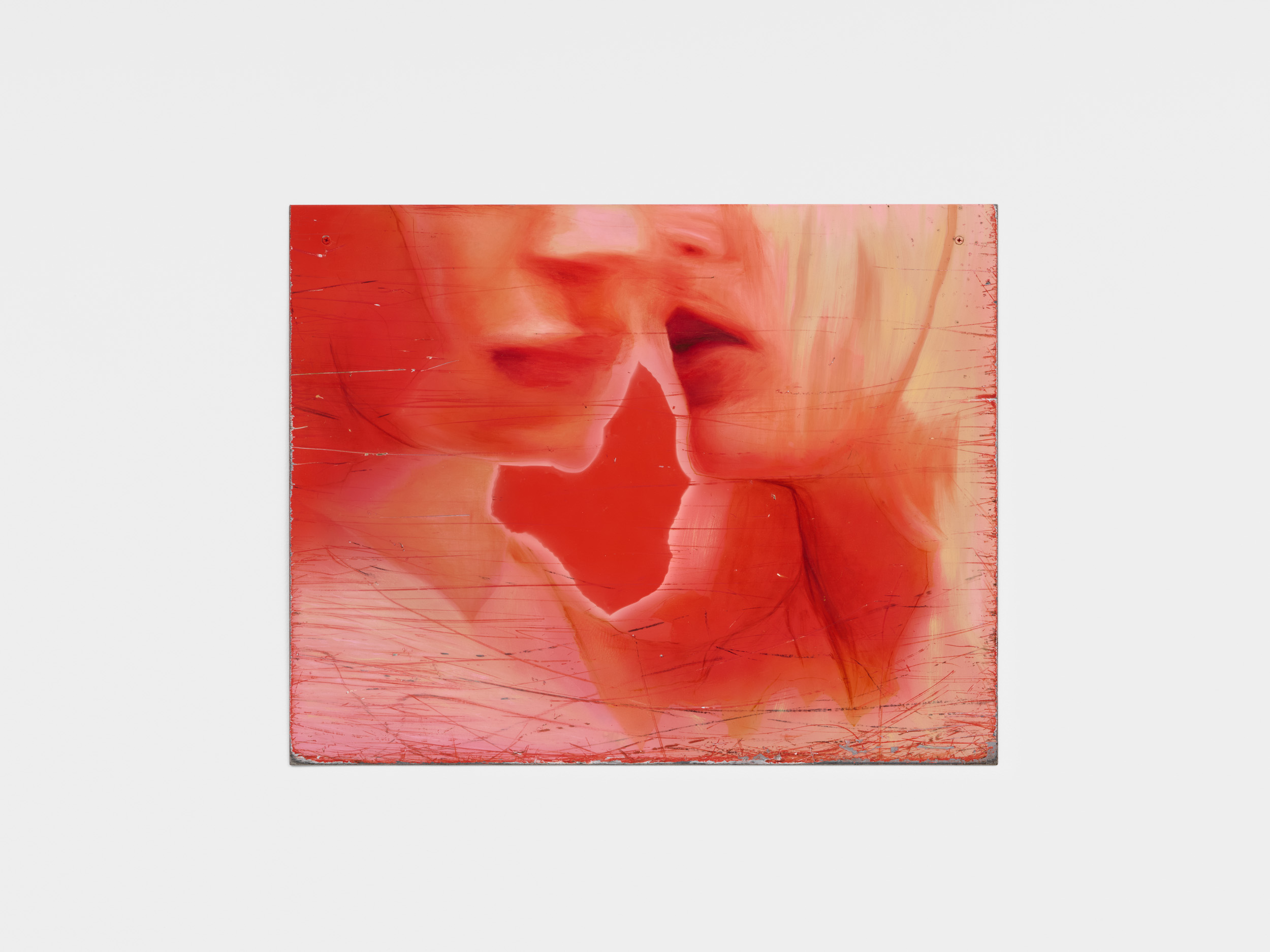
Base looks toward the foundation, to the degraded, stepped-over core of existence. The culmination of a decade’s development of material practice, Sam Lipp’s new series of paintings use the artist’s signature combination of oil on steel, including one work on a steel medical box. A third medium, frottage—Lipp’s distinctive process of mark-making through friction with sidewalk cement—emphasises these paintings’ unusual sturdiness while also testifying to ideas of bodily vulnerability and decay. A term used to describe the sexual rubbing of bodies against each other, frottage denotes the place where the harsh wear of urban existence and the circulation of the libidinal economy meet. In Lipp’s work, the marks left by the abrasion simultaneously resemble the remnants of an incompletely erased idea, the grotesque elegance of self-harm scars, and the ubiquitous wear visible on street signs and other civic infrastructure.
Arranged in a filmic sequence, the tripartite colourway system that orders the paintings begins with the earthy and bloody, before moving into greyish tones reminiscent of old videotape, and culminating in overexposed white. The structure the sequence provides hints at an undisclosed narrative, while also asking what the image, placed under the pressure of certain limits, can become. Affixed with screws, the paintings hint toward a utilitarian past while loudly announcing their present status as commodities. Again and again, we are compelled to confront the image as a property relation.
Lipp’s practice excels in drawing attention to how, in Christopher Chitty’s words, “the commodity form has transformed the essential coordinates of human sexuality.” Figures are depicted in closeup, often in poses of erotic recline that speaks to both a knowing pleasure taken in—and defiance of—the viewer’s gaze. The tattooed hand foregrounded in Censer beckons teasingly, emphasising the trompe l’œil effect of the medical box while instilling a surgical fantasy of opening up the figure’s torso to reveal what’s inside. The tight frame and reduction of bodies to their parts creates a vague sense of visual claustrophobia that brings to mind the cramped dimensions of the screen, the zoom function, the camera lens: an image that draws attention to its own production. An awareness of how images arrive to us pre-circulated surrounds these works, most obviously denoted by Lipp’s recurrent interest in the Getty Images watermark. Here, again, we are invited to reencounter the ultrafamiliar tropes of existence in capitalism, the signs and gestures that invite us in, and those that keep us out.
Everywhere, Lipp draws our attention to surface: to the complexity of its topography, to the image that announces itself as such. The glimpse, the hint, the archetype are prioritised over the search for an inner depth, as demonstrated by the works’ titles (Vagabond, Illegalist, Star). Evoking character types, these words eschew fantasies of bourgeois individuality even as the paintings themselves capture arrestingly particular expressions. In the same way, Lipp toys with depth, never letting us forget the image’s flimsiness, its ethereality. The screws piercing the paintings manually puncture the process of high-speed circulation, as if without them, they might float away, absorbed back into the manic highway of information, property, labour, and lust from which they came.
—Asa Seresin